
RateRewindCheaper is not enough. It has to be comparable.
Methodology
Cheaper is not enough. It has to be comparable.
A lower rental price is only a better offer if the conditions hold up. Almost any price can be pushed down by adjusting the vehicle class, the excess or the included mileage. This page sets out what we measure an offer against before we bother you with it at all.
RateRewind judges an offer on more than price, and always against the booking you already hold: vehicle class, insurance cover, mileage rule and payment terms all have to keep up. If any one of them is worse, the offer does not count as a match, however large the saving would be.
Updated: September 9, 2026
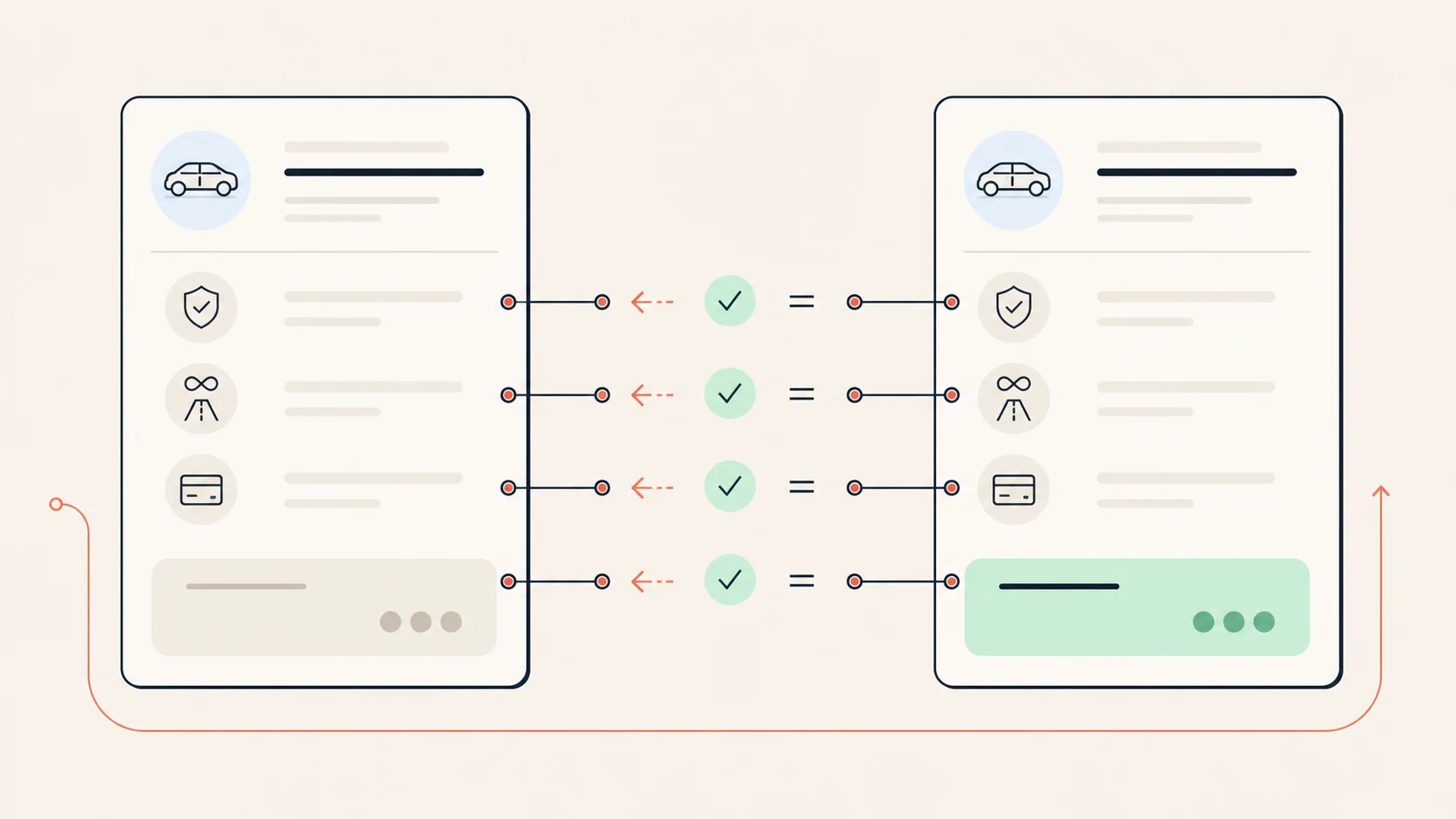
A lower price only counts with us if four things keep up:
- Vehicle class — a smaller car never counts as equivalent
- Insurance — weaker or unclear cover triggers no alert
- Mileage rule — a tighter cap than before does not count
- Payment — pay now or pay at the desk
What do we compare?
Four things, and always against your existing booking rather than a market average: vehicle class, insurance cover, mileage rule and payment terms. Our algorithm checks every offer it finds against those four before price enters the picture at all. If one of them comes out worse than your booking, it is not a match for us, even if it were a hundred euros cheaper.
Why a lower price on its own says nothing
Because almost any rental price can be brought down by adjusting the conditions. One class smaller, a 1,200-euro excess instead of zero, a mileage cap instead of unlimited: each of those moves makes the offer cheaper and leaves you worse off. A comparison that skips past this produces savings you repay at the rental desk. That is why comparability is the precondition here, not the extra.
How do we handle insurance products?
German brokers often sell their own excess reimbursement rather than arranging zero-excess cover with the supplier. Economically both come down to you not carrying the excess in the end, and we treat them accordingly. A cheap rate with a high excess, by contrast, is not a match just because the number in the price field is smaller. Where the cover is described unclearly, we decide against the alert.
Where does the market data come from?
From real searches run for bookings that people have registered with us, not from purchased lists or estimates. For the public station pages we separate observations by station, vehicle class and comparable rental length. Otherwise a long weekend lands in the same pot as a three-week trip, and their daily rates have little to do with one another.
When do we show numbers, and when not?
A station page only goes live once there are enough observations across different days, the data is current, and it spreads over several vehicle classes. Until then we deliberately show no statistics. A figure drawn from three searches looks precise and is worthless. Few bookings at a station therefore mean little public analysis, and that is by design.
What this methodology does not do
It is not a forecast, not a savings guarantee, and not live inventory you could book from. When we write that a particular window has been cheaper in the data so far, that is an observation about the past. Your station and your dates may behave differently. Which is exactly why there is a price watcher for your specific booking instead of a general recommendation.
Who decides in the end?
You do. RateRewind cancels nothing, books nothing and changes nothing about your reservation. We send you a note about the offer we found; what happens next is your call, in your broker's own portal. The threshold at which a note reaches you at all is yours to set as well.
Frequently asked questions
- Why don't you write on every cheaper price?
- Because most small price movements are not savings for you: once you count the effort, the wait for the refund and the extras to rebook, nothing is left. An email that gains you nothing is one email too many. So there is a threshold, and you set it yourself.
- Do you earn money when I rebook?
- Links to booking providers are affiliate links, and they do not change the price you pay. It has no bearing on the assessment: whether an offer counts as comparable is settled by vehicle class, insurance, mileage and payment terms, not by who we work with. A worse-fitting offer does not move up because it pays better.
- Why can a larger car be comparable but a smaller one not?
- Because an upgrade does not leave you worse off. If you get more car for less money, you have lost nothing. The other direction is different: an estate that turns into a city car may no longer fit your luggage or your passengers. The logic is not symmetrical here.
- Do you monitor non-cancellable bookings?
- No. Without the option to cancel you could not act on a lower price anyway, and the alert would only be annoying. The price watcher is therefore built for cancellable bookings with a pickup still ahead of you.
- What happens if a price source returns nothing?
- The check carries on with the remaining sources. One failing source must never abort a whole round, because that would leave gaps in the monitoring. The result in that case is simply less complete, not wrong.
Already have a cancellable booking?
Add it. We keep looking and only contact you when an equivalent offer is cheaper.
After signing in, you can add your booking straight away.
Links to booking providers are affiliate links. They do not change the price you pay. RateRewind does not rebook automatically.